
Arctic or Antarctic: what actually decides it
If your ship holds more than 500 passengers, you will never set foot on Antarctica. Not a bad seat, not a delay, never. It's not a Quark rule or a marketing line. It's a hard legal restriction that governs every operator in both polar regions, and most people shopping a "polar cruise" have no idea it exists until they're already standing on a deck looking at ice they can't touch.
That single rule tells you more about how to pick a polar trip than almost anything else, and it's where I start every conversation with a client who says they want to go to the Arctic or Antarctic.
The ship size rule nobody puts in the brochure
Here's how it actually breaks down. Ships over 500 passengers are cruise-only. You sail past the ice, you see it through a window or from a deck, and that's the whole experience. It's a scenic drive-by, not an expedition.
Ships between 200 and 500 passengers can land, but the restrictions are heavy. Only half the guests go ashore at a time, so you're either in the morning group or the afternoon group, and you get roughly 5 hours total in destination before you're back on board.
Anything under 200 passengers is true expedition class. Every guest can land, twice a day, with the flexibility to chase weather, ice conditions, or a wildlife sighting instead of sticking to a fixed schedule. Quark's largest ship, the Ultramarine, caps at 199 guests. That's not a coincidence. It's the number that keeps them inside the category that actually lets people off the boat.
If you remember one thing before booking either destination, remember this. The ship size decides your experience more than the itinerary does.
What you'll actually see in the Arctic
The Arctic wins on variety. This is where you find polar bears, Arctic fox, walrus, musk ox, reindeer, beluga whales, and a wider range of bird species than you'll see anywhere in Antarctica.
I think of the Arctic as four distinct destinations, not one. Svalbard is the headline stop, and it's sometimes called an African safari on ice. It's the single best place on earth to see a polar bear hunting and living on the sea ice, and walrus haul out at known, consistent spots. Greenland is a different animal entirely, built more around scale than wildlife. Massive glaciers calve chunks of ice the size of stadiums, and it's the region where helicopter-equipped ships can land guests directly on the polar ice sheet, a thousand meters of moving ice most people will never otherwise stand on. Iceland brings volcanic landscapes, geysers, and a circumnavigation option that mixes coastal exploration with inland national parks. The Canadian Arctic is the least visited of the four, centered on the old Northwest Passage exploration history and genuine Inuit culture, and while it isn't marketed as a polar bear destination, sightings there have been consistently strong the last few seasons.
None of it is guaranteed. Polar bears are opportunistic, not scheduled. But if a client's whole reason for going is "I want to see a polar bear," the Arctic, and Svalbard specifically, is the only honest answer.
What you'll actually see in Antarctica
Antarctica wins on volume. The Antarctic Peninsula itself is the classic image people picture with their eyes closed, ice and rock with almost no vegetation, and wildlife concentrated tightly along the coastline. You're looking at multiple penguin species, leopard seals, fur seals, elephant seals, and real odds at blue whales, fin whales, humpbacks, and orcas.
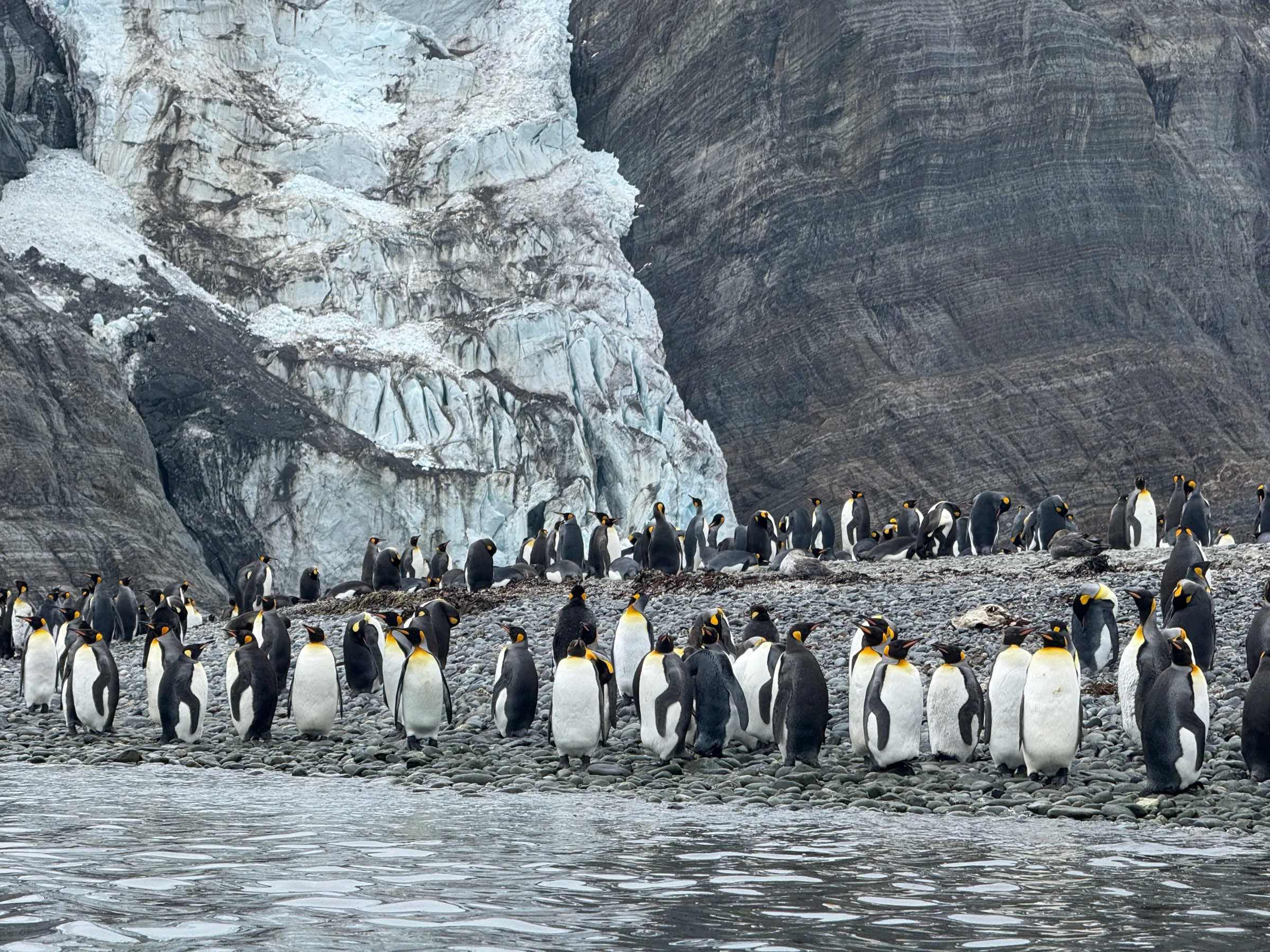
Beyond the Peninsula sit the Falklands and South Georgia, and this is where the numbers stop sounding real. Beaches with 400,000 penguins on them aren't an exaggeration, they're a normal day in South Georgia. The Falklands add huge nesting albatross colonies and species you won't see on the Peninsula, like king and crested penguins, along with genuine human history in Stanley.
There's also a rarer tier for travelers who've already done a standard Antarctic trip and want to go deeper. Snow Hill Island sits in ice-choked waters most seasons and is only reachable once or twice a year, but it holds one of the few accessible emperor penguin colonies on earth, a species that otherwise nests deep inland and almost never near the coast.
If a client can only do one trip, ever, Antarctica is where I point them. Not because the Arctic is lesser, but because the sheer volume and density of animal encounters is hard to match anywhere else on the planet.
Getting there matters more than people expect
Reaching either destination is part of the decision, not an afterthought. Antarctic voyages typically cross the Drake Passage, roughly two days each way by ship. Some operators now offer a fly option that turns that crossing into two hours each way, which can shrink an Antarctic expedition down to about 8 days total. That's a real consideration for clients juggling work schedules or anyone prone to seasickness who'd rather skip open ocean days entirely.
The Arctic has its own logistics. Svalbard and Greenland are difficult to reach on regular commercial flights, so operators typically run charter flights out of gateway cities like Helsinki or Reykjavik, with hotel nights included on either end. It sounds complicated on paper. In practice, a client just needs to get themselves to the gateway city, and the rest is handled.
Timing, and why you don't have to choose forever
The seasons don't overlap. Arctic season runs May through September. Antarctic season runs November through March, with a few operators stretching into late October and early April depending on ice conditions. That means a client could realistically do the Arctic in June and Antarctica in December of the same year.
If someone's set on doing both eventually, I tell them to do the Arctic first. The wildlife there is more elusive and opportunistic, so it rewards someone who isn't yet comparing it to Antarctica's density. Go the other way and the Arctic can feel quiet by comparison.
Frequently asked questions
Will I definitely see a polar bear if I book the Arctic?
No operator can guarantee it, wildlife doesn't work on a schedule. But Svalbard has one of the highest concentrations of polar bears anywhere in the world, and sightings on Quark's Svalbard voyages are consistent across the entire season.
Is a bigger ship ever the better choice for these destinations?
Only if landing isn't the point for you. A larger ship gets you scenery and comfort, not zodiac landings, helicopter flights, or time on the ice. If touching Antarctica matters to you, ship size under 200 passengers isn't optional.
What's the best time of year to see wildlife in Svalbard?
Consistency, not timing, is the answer. Quark has been running Svalbard voyages for over 35 years and books wildlife sightings across the entire May-to-August season. Early or late in the season, the encounters are comparable.
Can I do both the Arctic and Antarctic in one trip?
Not in one sailing, the seasons are opposite ends of the calendar. But you can absolutely do both in the same calendar year, one in northern summer and one in southern summer.
How do I know if an expedition ship is right for me physically?
If you can get from a couch to the floor and back up, you can get in and out of a zodiac. Most landings involve walking on uneven terrain at a pace groups can self-select, not technical hiking.
Which one should you actually book
If you want polar bears, Arctic fox, and walrus, the Arctic is the only place that delivers them. If you want the highest volume and density of wildlife encounters on a single trip, Antarctica is the stronger pick. Either way, book a ship under 200 passengers or you're paying for a view instead of an expedition.
Tell me what you actually want to see, and I'll tell you which season and which ship gets you there.