
The Arctic
Northern summer, five very different regions, and an inhabited polar world. Svalbard, Greenland, Iceland, Arctic Norway, and the Northwest Passage, with the eight operators genuinely running it this season.
Photo: Andreas Weith, CC BY-SA 4.0, via Wikimedia Commons
- The Arctic season is the Northern Hemisphere summer, roughly May through September, the exact reverse of Antarctica.
- Destinations are Svalbard, Greenland, Iceland, Arctic Norway, Arctic Canada, and the Northwest Passage, not a single peninsula.
- Unlike Antarctica, the Arctic is inhabited: Inuit and Sámi communities, trading posts, and research stations are part of the itinerary.
- Late June through early August is the strongest polar bear window in Svalbard, when ships can reach the pack ice edge.
- Northwest Passage transits run only in August and September, take two to three weeks, and are never guaranteed to complete.
What Arctic expedition travel actually is
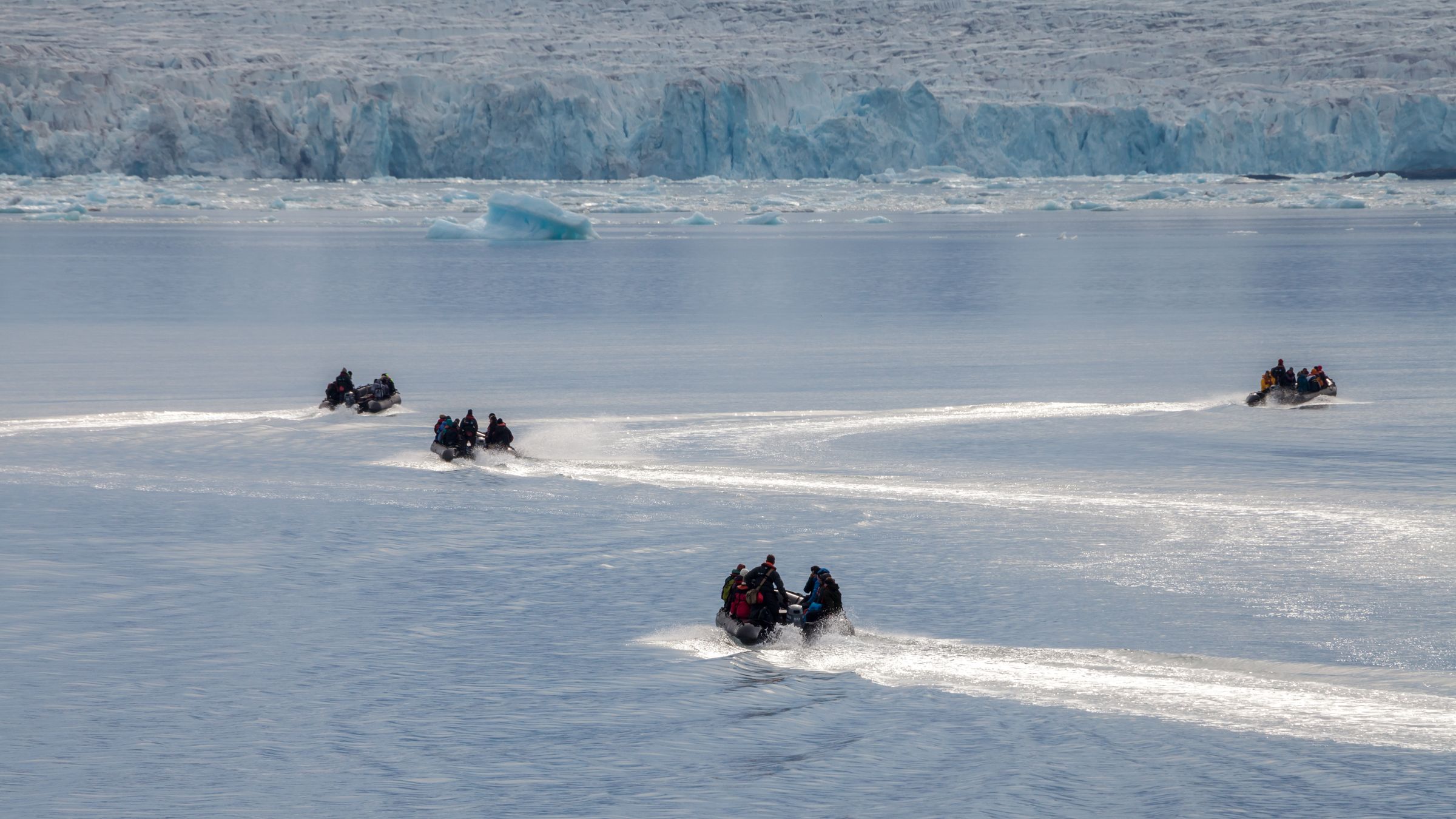
An Arctic expedition puts 100 to 300 guests on an ice-strengthened ship and takes them to coastlines with no pier and usually no town: glacier fronts in Svalbard, fjord systems in East Greenland, the pack ice edge above 80 degrees north. You get ashore by Zodiac, an expedition team of naturalists, glaciologists, and historians runs the day, and the published itinerary is a statement of intent that ice and weather are free to rewrite.
The two things people get wrong are seasonality and geography. Seasonality is reversed from Antarctica: the Arctic season is the Northern Hemisphere summer, roughly May through September, peaking in July, while Antarctica runs November through March. Geography is plural rather than singular. Antarctica is effectively one destination, the Antarctic Peninsula, plus the South Georgia and Falklands extension. The Arctic is five regions across three continents, and Svalbard in July has almost nothing in common logistically with a Northwest Passage transit in September.
The third difference matters more than travelers expect: the Arctic is inhabited. There are Inuit settlements in Greenland and Nunavut, Sámi communities in northern Norway, working coal towns, research stations, and national borders with real customs procedures. Antarctica has no permanent population and no sovereign territory. That single fact changes the texture of the trip, and it is why an Arctic voyage often feels as much cultural as it does wild.
A northern summer season, region by region
The month you pick largely picks the region, and the wildlife, for you.
May and early June, fast ice and returning light
Snow still covers the tundra, fjord ice is breaking up, and the light is at its most dramatic. Access to the far north of Svalbard is limited by remaining ice, so itineraries stay south and west. Excellent for landscape photographers and early-season walrus, weaker for reaching the pack ice edge.
Late June through early August, peak season
The strongest window for polar bears, full Spitsbergen circumnavigations, pack ice access, and 24-hour daylight. Greenland fjords open up, seabird cliffs are at maximum activity, and every operator runs its flagship routing. It is also the most expensive and the first to sell out.
Late August and September, ice-out and transits
Sea ice is at its annual minimum, which is precisely why Northwest Passage transits and the deepest Canadian High Arctic routings happen now. Whales are abundant, autumn color arrives on the tundra, and darkness returns enough for the first aurora of the season in the lower Arctic.
There is no Antarctic-style single window
Because the Arctic spans five distinct regions across three continents, the calendar is regional rather than continental. Svalbard peaks in July, Northwest Passage in late August, Norway's aurora season in the dark months. The month you choose largely chooses the region for you.
The Arctic regions, and what each one is for
Svalbard, sailing from Longyearbyen
The most reliable polar bear destination in the world, plus walrus haul-outs, glacier fronts, and seabird cliffs. Flights connect through Oslo or Tromsø. Most voyages run 6 to 12 days, either a west-coast route or a full circumnavigation depending on ice.
Greenland and Iceland
Enormous fjord systems, Ilulissat's icebergs, Inuit settlements, and hot-spring and volcanic coast on the Icelandic side. Frequently sold as a combined crossing over the Denmark Strait, which gives you two very different countries in one voyage.
Arctic Norway and the Northwest Passage
Norway delivers Lofoten, North Cape, and coastal culture with the easiest logistics in the Arctic. The Northwest Passage sits at the other extreme: two to three weeks through the Canadian Arctic Archipelago, charter flights at both ends, and an itinerary written by the ice.
What a typical day looks like
With 24-hour daylight in peak season, the schedule bends around ice and wildlife rather than the clock.
- Step 1
Scouting before you wake
The expedition leader and bridge team scan for ice, weather, and wildlife long before breakfast. In peak summer the sun never sets, so a bear on the ice at 2 a.m. can and does change the entire day's plan.
- Step 2
Morning Zodiac operation
You gear up in the mudroom, board a Zodiac from the shell door, and either cruise a glacier front and bird cliff or make a landing on open tundra. Polar bear guards with rifles establish a perimeter before any Svalbard landing, which is a legal requirement, not theater.
- Step 3
Ashore, or along the ice
Landings mean tundra walks at several paces, from a photography-slow group to a longer hike, always inside the guarded perimeter. When landing is not possible, the day becomes ship cruising along the pack ice edge, which is often where the best bear sightings actually happen.
- Step 4
Community and history stops
This is the part Antarctica does not have. Depending on region you may visit an Inuit settlement in Greenland or Nunavut, a Sámi community in northern Norway, a whaling or trapping station, or Beechey Island and other Franklin expedition sites.
- Step 5
Evening recap and repositioning
The team recaps the day, lectures on glaciology, Arctic ecology, or Inuit history, and previews tomorrow with the honest caveat that ice decides. Overnight the ship repositions, often several hundred nautical miles.
Physical demands and realistic cost
- Step into and out of a moving Zodiac, sometimes into shallow water.
- Walk on uneven tundra, scree, and snow, inside a guarded perimeter.
- Tolerate cold, wind, and spray, and dress in real layers rather than fashion ones.
- Sleep with 24-hour daylight, which needs a proper eye mask and some discipline.
- Accept open-water crossings, including the Denmark Strait on Greenland pairings.
- Roughly 800 to 2,500 per person per day, before international flights.
- One-week Svalbard voyage: commonly 7,000 to 15,000 per person.
- Greenland and Iceland combinations: similar range, longer sailings run higher.
- Northwest Passage transit, 2 to 3 weeks with charter air: 25,000 to 40,000 and up.
- Add gateway hotels in Longyearbyen or Reykjavík, gear, and evacuation-grade insurance.
The eight operators running the Arctic now
Each of these is confirmed running current Arctic product. They are not interchangeable, and the right one depends on the region and the routing.
Quark Expeditions
The polar specialist with the deepest Arctic bench: Svalbard, Greenland, Canadian High Arctic, and Northwest Passage transits aboard Ultramarine, with helicopter-supported programming where regulations permit. The first call when you want the most ambitious routing available.
Aurora Expeditions
Small-ship, activity-forward Arctic sailings on their Infinity-class vessels, with sea kayaking, snorkeling, and hiking treated as core rather than upsell. Guest counts stay low, which shows in how quickly everyone gets ashore.
HX Expeditions
The Norwegian operator with the longest continuous Arctic history, running Svalbard, Greenland, Iceland, and Northwest Passage voyages on hybrid-powered ships with Science Centres and citizen-science programming aboard.
Ponant
French luxury applied to the polar regions, including Le Commandant Charcot, the hybrid-electric icebreaker capable of reaching the geographic North Pole and high-latitude Greenland routings no conventional expedition ship can attempt.
Aqua Expeditions
New for 2026, and their first Arctic season ever: Svalbard and Arctic Circle itineraries aboard Aqua Lares, bringing the intimate, design-led small-ship model they built in the Amazon and Galápagos into the high north.
Lindblad Expeditions
The National Geographic partnership, with the strongest naturalist and photography programming in the Arctic across Svalbard, Greenland, Iceland, and Canadian High Arctic routings. The choice when interpretation matters as much as access.
Silversea
Ultra-luxury expedition with all-suite accommodation, butler service, and included charter air on many Arctic departures. Silver Endeavour and fleet sisters cover Svalbard, Greenland, and Iceland without asking you to give up the comforts.
Scenic
Scenic Eclipse discovery yachts, all-inclusive to an unusual degree, with onboard helicopters and a submersible on selected Arctic departures. Svalbard, Greenland, Iceland, and Norway, with the broadest set of toys in the category.
Our honest take on planning the Arctic
The Arctic is on my own travel list, and I'm honest about that with clients: I haven't sailed there myself yet. As Travel Agent and Head of Corporate and Incentive Travel and Expedition Cruises at Travel Squad Vacations, I bring direct relationships with the operators who have, including Lindblad and Quark, along with Scenic. I vet supplier itineraries, current ship deployments, and route offerings before recommending them, so what you see on this page reflects what's actually running this season, not outdated marketing copy.
Practically, that means we start with the month and the region rather than the ship. If polar bears are the reason you are going, we point you at late June through early August in Svalbard and at itineraries that actually reach the pack ice edge. If the Northwest Passage is the goal, we plan for a two to three week window in late August and September, charter flights at both ends, and the real possibility that ice reroutes the voyage.
If you are still deciding whether expedition travel suits you at all, our expedition travel hub covers the category from the beginning.
The Arctic, frequently asked questions
When is the best time to see polar bears in Svalbard?
Late June through early August is the strongest window. Sea ice has retreated far enough north that ships can reach the pack ice edge and circumnavigate Spitsbergen, which is where bears concentrate, and the midnight sun means sightings can happen at any hour. May and early June offer more fast ice and dramatic light but less northern access, while late August and September trade bear odds for walrus, whales, and the first autumn color. No operator guarantees a sighting; itineraries that include the pack ice edge or a full circumnavigation give you the best statistical chance.
What does a Northwest Passage voyage actually involve?
A Northwest Passage transit is a two to three week point-to-point voyage through the Canadian Arctic Archipelago, typically between Greenland and Alaska in August and September, the only weeks the route is reliably navigable. Expect charter flights at one or both ends, Inuit community visits in places like Pond Inlet, Beechey Island and Franklin expedition history, and genuine route flexibility because ice conditions decide the path. Ships are ice-class, guest counts are small, and a full transit is not guaranteed; operators publish alternate routings for years when ice does not clear.
How is Arctic expedition cruising different from an Alaska cruise?
An Alaska cruise sails the Inside Passage on a large ship, docks at towns like Juneau, Ketchikan, and Skagway, and sells shore excursions from a desk. An Arctic expedition carries 100 to 300 guests on an ice-strengthened ship, lands by Zodiac on uninhabited coast in Svalbard, Greenland, or Arctic Canada, and follows an itinerary that changes with ice, wind, and wildlife. Alaska is scenic cruising with infrastructure. The Arctic is access to places with no pier, no town, and no fallback plan, at roughly two to four times the daily cost.
How does the Arctic season differ from Antarctica?
The seasons are reversed. Antarctica runs November through March, the Southern Hemisphere summer. The Arctic runs roughly May through September, the Northern Hemisphere summer, with a short aurora-focused shoulder in Norway later in the year. The Arctic is also inhabited: you will meet Inuit and Sámi communities, visit trading posts and research stations, and cross national borders. Antarctica has no permanent population and no sovereign territory, so the itineraries feel fundamentally different even when the ice looks similar.
Where do Arctic expedition itineraries actually go?
Five broad regions. Svalbard for polar bears, walrus, and glacier fronts, sailing from Longyearbyen. East and West Greenland for fjords, icebergs, and Inuit settlements. Iceland for volcanic coast and puffin colonies, often paired with Greenland. Arctic Norway for the fjords, Lofoten, and North Cape. And the Canadian High Arctic and Northwest Passage for the most remote, most weather-dependent routing of all. Most first-time Arctic travelers start with Svalbard or a Greenland and Iceland combination.
What does an Arctic expedition cost?
Plan on roughly 800 to 2,500 US dollars per person per day before flights. A one-week Svalbard voyage commonly lands between 7,000 and 15,000 dollars per person, Greenland and Iceland combinations run similar, and a two to three week Northwest Passage transit with charter flights frequently exceeds 25,000 to 40,000 dollars. Compare landed cost rather than headline fare: charter air, Longyearbyen or Kangerlussuaq positioning, gear, and evacuation-grade insurance vary widely between operators.
Related reading
Ready to travel better?
Tell us where you're dreaming of, and one of our advisors will be in touch within two business days.
Mon – Fri 9 AM – 6 PM · Sat 9 AM – 5 PM