
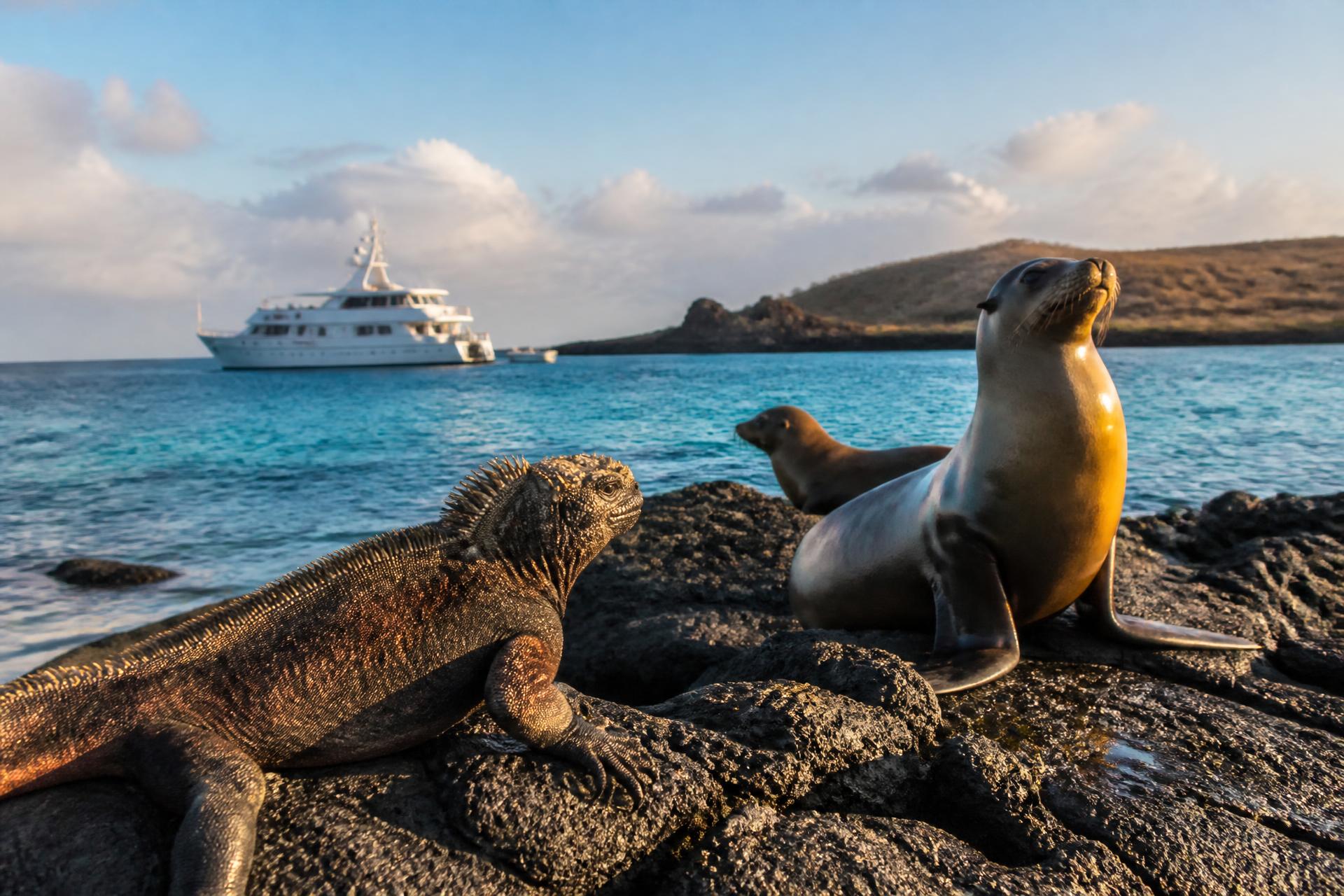
Galápagos Islands
A year-round destination with two very different seasons. What it costs, how you get there, what a day actually looks like, and how to choose among the five operators worth considering.
- Year-round destination, unlike Antarctica's five-month window; the season you pick changes the wildlife, not whether you can go.
- December through May is warmer and calmer for snorkeling; June through November is cooler, choppier, and stronger for big marine life.
- Fly into Quito or Guayaquil, then a 2 to 3 hour domestic flight to Baltra or San Cristobal.
- Every visitor pays 200 dollars in park fees plus a 20 dollar Transit Control Card at the airport, not through the cruise line.
- Realistic budget is 4,500 to 8,000 per person for a 7 or 8 day small-ship itinerary, before international flights.
Two seasons, no closed season
The Galápagos runs all year. What changes is water temperature, sea state, and which wildlife behavior you get to witness.
Warm and wet season, December through May
Warmer air and water, around 75 to 80 degrees Fahrenheit, and calmer seas. This is the most comfortable window for snorkeling, with marine iguana mating displays and the most active land birds. Short tropical rain showers come with the warmth.
Cool and dry garua season, June through November
Cooler air and water, roughly 68 to 72 degrees, with choppier seas and higher nutrient upwelling. The strongest window for big-animal marine life, including whale sharks near Darwin and Wolf, and the season most divers and marine-wildlife travelers target.
Albatross on Espanola, April through December
Waved albatross are present on Espanola from April into December, a species-specific window that often decides the month for birders. If albatross are on your list, the calendar is set for you.
There is no closed season
Unlike Antarctica, the Galapagos operates all year. That means the decision is about water temperature, sea state, and which wildlife behavior you want to witness, rather than squeezing into a five-month window.
Gateway cities and how you reach the islands
Quito or Guayaquil, Ecuador
Your international gateway. Every Galapagos trip routes through one of these two mainland cities before continuing to the islands. Which one you use often depends on your airline routing and whether you want to add mainland Ecuador time.
Baltra or San Cristobal in the islands
From the mainland you take a 2 to 3 hour domestic flight to one of the two island airports, where you meet your ship. Which airport you use is set by your itinerary, not by preference.
Park fees and buffer nights
Every visitor pays a 200 dollar Galapagos National Park entrance fee plus a 20 dollar Transit Control Card, by cash or card at the airport, not prepaid through the cruise line. Because domestic flight delays are frequent, at least one buffer night in Quito or Guayaquil is standard practice.
What a typical day looks like
Where Antarctica is built around Zodiac landings, the Galápagos rhythm pairs walks ashore with time in the water.
- Step 1
Morning briefing and first landing
Days start early. Your licensed naturalist guide, mandatory by Ecuadorian law, briefs the group before you board a panga, the dinghy that carries you ashore. Landings are either wet, stepping into shallow water, or dry, stepping onto rock.
- Step 2
Guided walk on marked trails
Ashore you follow marked trails with your naturalist, which is required rather than optional. The trails exist to protect nesting sites and fragile lava terrain, and the guide interprets what you are looking at as you go.
- Step 3
Snorkeling from the panga
Rather than an organized excursion, snorkeling here usually happens straight off the panga, often alongside sea lions, sea turtles, and rays. This is where a great deal of the archipelago's best wildlife encounters occur.
- Step 4
A second site in the afternoon
Two islands or sites per day is typical on a 7 or 8 day itinerary. The afternoon often pairs a second walk with another swim or panga ride along a shoreline.
- Step 5
Evening recap
The guide recaps the day, previews tomorrow's sites, and explains what to expect. Unlike Antarctica's ice-driven improvisation, Galapagos site visits are allocated under park permits, so the plan holds more firmly.
Physical demands and realistic cost
- Be comfortable snorkeling. Optional, but core to the experience here.
- Walk on uneven lava rock and soft sand on marked trails.
- Step into and out of a moving panga, sometimes into shallow water.
- Tolerate strong equatorial sun, with real sun and reef protection.
- Handle choppier seas if you travel in the June to November garúa season.
- 7 or 8 day small-ship itinerary, 16 to 100 guests: 4,500 to 8,000 per person.
- Ultra-luxury, Silver Origin or premium Endeavour II suites: 10,000 to 18,000 and up.
- Park entrance fee: 200 dollars per person, paid at the airport.
- Transit Control Card: 20 dollars per person, also paid at the airport.
- Ecuador-side flights and buffer hotel nights: roughly 800 to 1,500 more.
How to choose between Galápagos operators
Five operators are genuinely worth your attention in the islands. Each one is best at something specific.
Lindblad Expeditions
The naturalist and National Geographic partnership standard, aboard National Geographic Endeavour II and Islander II. The deepest interpretive and photography programming in the islands, and the choice when understanding what you are seeing matters as much as seeing it.
Aqua Expeditions
The archipelago's founding modern operator, established in 2007. Luxury small-ship travel with superyacht-style intimacy aboard Aqua Mare, built for smaller groups who want the islands without a crowd.
Silversea
Silver Origin was purpose-built specifically for the Galapagos rather than adapted to it. An ultra-luxury all-suite ship designed around the destination, which shows in everything from the platform layout to the guide ratio.
Quark Expeditions
A newer entrant to the region, carrying the small-ship expedition approach from their polar operations into the islands. Familiar territory for travelers who already know and like how Quark runs a voyage.
HX Expeditions
Santa Cruz II, with an onboard Science Centre and real citizen-science programming, plus strong access to up to 13 islands via small expedition boats. Intellectual depth paired with genuinely broad coverage.
Our honest take on planning the Galápagos
The Galápagos rewards a different kind of planning than Antarctica. There is no five-month window to squeeze into, so the real work is matching the season to what you want to see, then matching the ship to how you want to spend the week. Snorkeling comfort in December through May, or big marine life and whale sharks in the cooler garúa months. Both are excellent trips. They are not the same trip.
The logistics people underestimate are on the Ecuador side, not in the islands. Domestic flights out to Baltra and San Cristóbal are delayed often enough that we treat a buffer night in Quito or Guayaquil as standard rather than optional, and we make sure clients know the 200 dollar park fee and 20 dollar transit card are paid in person at the airport rather than bundled into their cruise fare.
Ship size and guide quality matter more here than amenities. A licensed naturalist is required by law on every walk, so the differentiator is how good that guide is and how many people they are talking to at once. If you are still deciding whether expedition travel suits you at all, our expedition travel hub covers the category from the beginning.
Galápagos, frequently asked questions
How much does a Galapagos cruise cost?
A realistic range is 4,500 to 8,000 US dollars per person for a 7 or 8 day small-ship itinerary carrying 16 to 100 guests, before international flights. Ultra-luxury options such as Silver Origin or premium suites on National Geographic Endeavour II run 10,000 to 18,000 dollars and up. Add the 200 dollar national park entrance fee and 20 dollar Transit Control Card, plus Ecuador-side flights and buffer hotel nights, roughly 800 to 1,500 dollars more.
When is the best time to visit the Galapagos Islands?
The Galapagos is a year-round destination, so the question is what you want rather than whether a month works. The warm and wet season, December through May, brings air and water near 75 to 80 degrees Fahrenheit, calmer seas, the most comfortable snorkeling, marine iguana mating displays, and active land birds. The cool and dry garua season, June through November, runs 68 to 72 degrees with choppier seas but stronger nutrient upwelling, the best big-animal marine life including whale sharks near Darwin and Wolf, and albatross on Espanola from April through December.
Do I need to know how to snorkel for a Galapagos trip?
Snorkeling is optional, but it is core to the experience, and comfort in the water is a real asset here. Much of what makes the archipelago extraordinary happens just below the surface, alongside sea lions, sea turtles, and rays, entered directly from the panga. Beyond swimming, you need to walk on lava rock and sand, board a moving panga, and tolerate strong equatorial sun. Cold-weather gear matters far less than in Antarctica; sun protection, reef safety, and swimming ability matter far more.
How do I get to the Galapagos Islands?
You fly first into Quito or Guayaquil, Ecuador, the international gateways, then take a 2 to 3 hour domestic flight out to Baltra or San Cristobal in the islands. Every visitor pays a 200 dollar Galapagos National Park entrance fee plus a 20 dollar Transit Control Card, both paid at the airport rather than prepaid through the cruise line. Because domestic flight delays are frequent, at least one buffer night in Quito or Guayaquil is standard practice.
Which cruise line is best for the Galapagos?
Five operators are worth your attention, each best at something specific. Lindblad Expeditions sets the naturalist standard through its National Geographic partnership. Aqua Expeditions, the archipelago's founding modern operator, offers superyacht-style intimacy aboard Aqua Mare. Silversea's Silver Origin was purpose-built for the Galapagos rather than adapted to it. Quark Expeditions carries its polar small-ship approach into the region. HX Expeditions runs Santa Cruz II with an onboard Science Centre and access to up to 13 islands. We match the ship to how you actually want to spend the week.
Related reading
Ready to travel better?
Tell us where you're dreaming of, and one of our advisors will be in touch within two business days.
Mon – Fri 9 AM – 6 PM · Sat 9 AM – 5 PM