
Which expedition line is actually best for photographers?
Not every expedition line treats photography the same way. Some build an entire paid program around it. Some include an expert photographer in the price of the trip. Some skip a formal program entirely and just help you get a nice shot in the moment. Knowing which is which matters more than most people realize before they book.
Here's how Quark, Lindblad, Aurora, and Scenic actually compare.
Quark: a dedicated program, but it costs extra
Quark runs a guided photography program as a paid add-on, priced at 1,395 in the Arctic and 1,595 in Antarctica. Guests who sign up get their own dedicated zodiac, a professional photography guide, and extra time on the water specifically built around getting the shot, not just seeing the wildlife.
This is a real program, not a marketing label. Quark piloted it in Svalbard, and the feedback was consistent in both directions. Advanced photographers, the kind carrying a $10,000 lens without blinking, got everything they wanted out of the extra time and expert positioning. Beginners left feeling like intermediate photographers, with actual coaching on shutter speed and exposure for polar conditions, not just a lecture about composition after dinner.
If a client wants to treat photography as the primary reason for the trip, not a side benefit, Quark's program is built for exactly that, as long as they're comfortable paying for it separately. It's also worth remembering that Quark's ships operate under the same true expedition-class rules as the rest of this category, under 200 passengers, which is part of why a dedicated photography zodiac is even logistically possible. A bigger ship simply doesn't have the flexibility to peel off a specialty group without disrupting everyone else's day.
Lindblad: included, and tied to a name that means something
Lindblad takes a different approach. Every single Lindblad polar voyage includes a National Geographic-certified photography expert, built into the fare rather than sold as an add-on. These aren't general naturalists moonlighting as photo help. They're specifically trained to work one-on-one with guests, on deck and inside zodiacs, adjusting camera settings in real time to help capture a breaching whale or a passing iceberg.
The value here isn't just the instruction, it's the partnership behind it. A National Geographic name attached to a photography credential carries weight that a generic "onboard photographer" title doesn't. For a client who wants expert-level coaching without paying an additional fee on top of an already premium fare, Lindblad is the strongest fit of the four.
Aurora: included instruction for every skill level
Aurora's approach sits close to Lindblad's model. Photography Guides and Special Guest Photographers are part of the standard voyage experience, offering one-on-one instruction both onboard and during shore excursions, regardless of whether a guest is shooting with a full kit or a smartphone. Aurora frames this explicitly as accessible to any skill level, someone taking their first real photos and someone who's been shooting for decades.
What sets Aurora apart slightly from Lindblad is the framing around community. Photography guests aren't just getting instruction, they're grouped with other travelers who share the same interest, which tends to make the whole voyage feel more like a shared pursuit than an individual lesson.
If a client wants included, real-time coaching without the specific National Geographic branding, and values traveling alongside other photography-minded guests, Aurora is a strong, less commonly considered option.
Scenic: no dedicated program, but real support in the moment
Scenic is the outlier of the four. There's no formal photography program, no dedicated guide role built around teaching technique. What Scenic does offer is help capturing guests in the moment, staff and expedition team members assisting with photos during excursions, not structured instruction.
That's not a knock on Scenic. It reflects where Scenic's actual strength lies, comfort, service, and inclusions, not a photography curriculum. A client whose priority is getting a great photo of themselves in front of a glacier will still be well served. A client who wants to leave the trip a measurably better photographer should look at one of the other three lines instead.
Who actually fits where
The serious photographer, the one who already owns the gear and wants to maximize technical opportunity, is best served by Quark's paid program or Lindblad's included expert, depending on whether they'd rather pay extra for a dedicated zodiac or get expert coaching built into the fare.
The traveler who wants noticeably better vacation photos without turning the trip into a photography course fits well with Aurora or Lindblad, both of which build real instruction into a voyage that's still primarily about the destination.
The traveler who just wants a great photo of the experience itself, not a lesson in how to take one, doesn't need to prioritize any of this. Scenic, or any of the other lines without a dedicated photo focus, will still deliver a great shot with a little help from the crew.
Frequently asked questions
Which expedition line has the best photography program?
It depends on what "best" means to the traveler. Quark offers the most dedicated, paid experience with its own zodiac and guide. Lindblad includes a National Geographic-certified expert in the fare. Aurora includes similar one-on-one coaching without the added cost of a specialty program.
Do I need expensive camera gear to benefit from these programs?
No. Aurora specifically frames its photography instruction as valuable regardless of gear, smartphone or full kit, and the same holds true across Lindblad and Quark. The coaching is built to meet a guest at their actual skill level.
Is Quark's photography program worth the extra cost?
For a client whose primary goal is improving their photography, yes. It includes a dedicated zodiac and guide, which most included programs don't offer. For a client who wants good photos without a specialized add-on, Lindblad or Aurora may be a better value fit.
Does Scenic offer any photography support at all?
Scenic doesn't run a formal instructional program, but staff and expedition team members do help guests capture photos during excursions. It's built around service, not technique-building.
Which line is best for a total beginner?
Aurora and Lindblad both build instruction into the standard experience, which makes them a lower-pressure entry point than a specialty paid add-on. Quark's program is also beginner-friendly, guests in the pilot program left with real skill gains, but it does come at an additional cost.
The actual decision
If photography is the whole reason for the trip, Quark's paid program or Lindblad's included expert are the strongest options, and the choice between them comes down to whether a client would rather pay extra for a dedicated experience or get expert coaching folded into the fare. If a client wants meaningfully better photos without treating the trip like a class, Aurora and Lindblad both deliver that as standard. If photography is a nice-to-have rather than a priority, Scenic will still get a client a great photo, just without the instruction behind it.
Tell me how much photography actually matters to your trip, and I'll tell you which line and which ship gets you there.
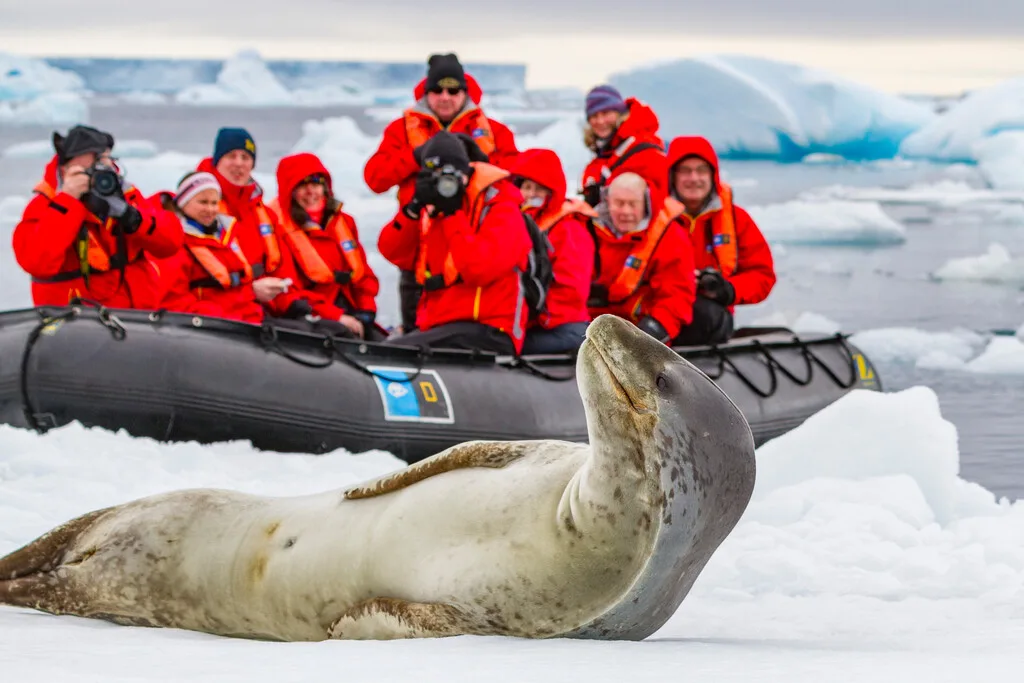
Photo Credit: Guests photograph a leopard seal near Brown Bluff, Antarctica. Photo by Michael S. Nolan, courtesy of Lindblad Expeditions-National Geographic.